

- Free online proofs
- Fast turnaround
- Secure checkout
November 15, 2026
Flyers and brochures at a glance
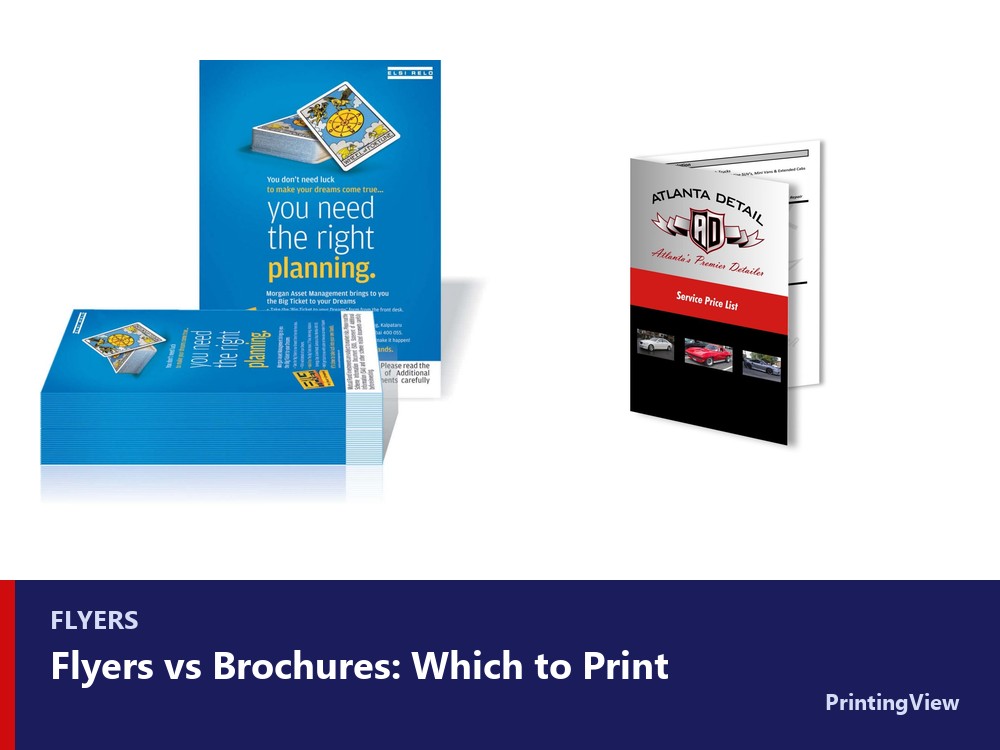
Both are printed marketing pieces, but they do different jobs. A flyer is usually a single sheet with one clear message. A brochure is folded, with several panels, and gives you room to explain more. Choosing the right one saves money and gets a better response.
Side-by-side comparison
| Feature | Flyer | Brochure |
|---|---|---|
| Format | Usually a single sheet, printed on one or both sides | Folded sheet with several panels |
| Best for | Offers, events, openings, menus, announcements | Services, product ranges, company overviews, sales packs |
| Amount of content | Short and focused | Detailed and structured |
| Typical sizes | 8.5 x 11 in, 4 x 6 in | Letter-size and larger sheets folded to panels |
| Distribution | Hand-outs, local drops, inserts | Reception desks, trade shows, mailings, sales visits |
| Cost per piece | Usually lower | Usually higher, because of size and folding |
When a flyer is the better choice
- You are promoting a time-limited offer or an event.
- You want to cover a local area quickly and cheaply.
- You need one clear call to action, such as a visit, call or booking.
See our flyer printing options, including 8.5 x 11 flyers and 4 x 6 flyers, and read the flyer printing guide.
When a brochure is the better choice
- You offer several products or services that need explaining.
- Customers compare options before they buy.
- You want something professional to leave behind after a meeting.
See our brochure printing page for sizes and folds, and read the brochure printing guide.
Using both together
A common approach is to use a flyer to attract attention and a brochure to follow up. Hand out flyers locally with a single offer and a web address or QR code, then give interested people a brochure with the full range. Your business card completes the set.
Choosing on budget and goal
- Define the goal: awareness and response, or detailed information.
- Count the content: if it fits in a headline, an image and three lines, use a flyer.
- Think about where it will be used: hand-outs favour flyers; desks and meetings favour brochures.
- Order enough for repeat use. Unit cost falls as quantity rises.
For help choosing, use the free quote form. You approve a free proof before printing.
Frequently asked questions
What is the difference between a flyer and a brochure?
A flyer is usually a single sheet with a short message. A brochure is folded into panels and holds more detailed information.
Which is cheaper, flyers or brochures?
Flyers usually cost less per piece because they are smaller and not folded. Exact costs depend on size, paper and quantity.
Can I use flyers and brochures together?
Yes. Use flyers to attract attention and brochures to give interested people more detail.
What size is a standard flyer?
The most common flyer size is 8.5 x 11 inches. 4 x 6 inches is popular for quick hand-outs.
What is the most common brochure fold?
The tri-fold is the most common. It folds a letter-size sheet into six panels.
Can I get a proof before printing?
Yes. A free digital proof lets you check layout, colours and text before production.
