

- Free online proofs
- Fast turnaround
- Secure checkout
November 08, 2026
Why use brochures?
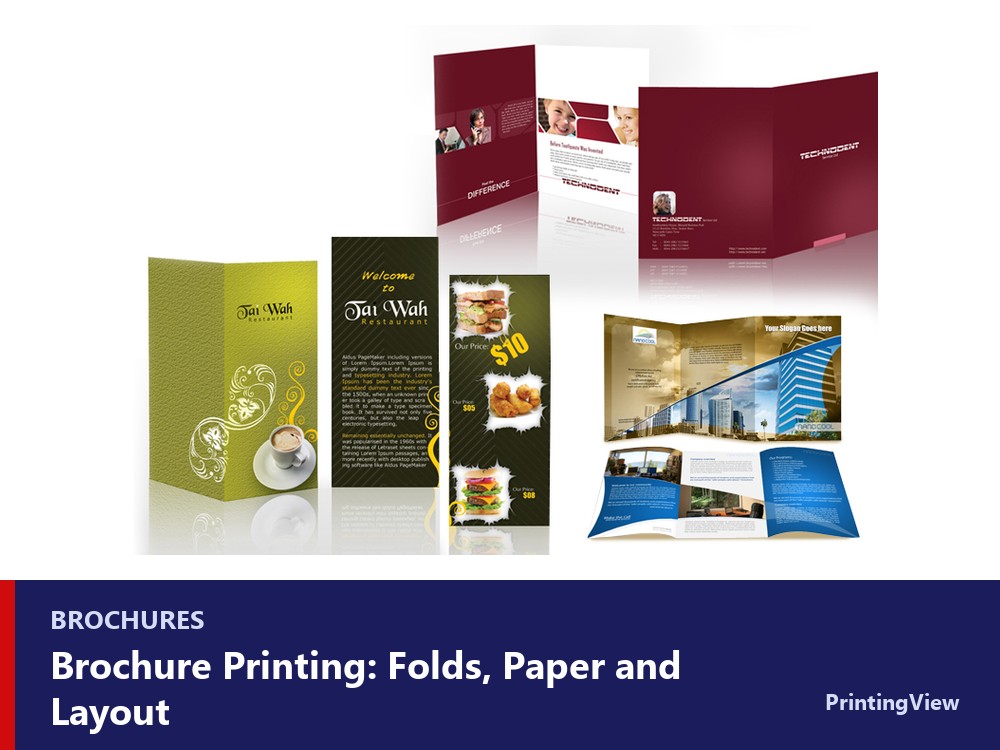
A brochure lets you explain a product or service in more depth than a flyer. It works on a reception desk, at trade shows, in sales packs and in mailings, and it gives a prospect something to keep and share. For a quick offer or event, a flyer is usually enough; for detail, choose a brochure.
Common brochure folds
| Fold | Panels | Best for |
|---|---|---|
| Bi-fold | 4 | Menus, short product stories, price lists |
| Tri-fold | 6 | Services, company overviews, the classic business brochure |
| Z-fold | 6 | Step-by-step content, timelines |
Brochure sizes
A tri-fold is commonly made from an 8.5 x 11 inch sheet, folding to panels of about 3.67 x 8.5 inches. Larger sheets give more room; see 8.5 x 11 brochures, 8.5 x 14 brochures and 11 x 17 brochures. Choose the size based on how much content you have and how the brochure will be handed out.
Paper and finish
For brochures, 100 lb gloss or silk text is a good everyday choice, with colours that look rich and a good folding performance. Heavier cover stock feels premium but folds less crisply unless it is scored, so ask for scoring on thicker paper to prevent cracked folds. Uncoated stock suits a natural, writable look.
Structuring brochure content
- Front panel: your name or logo, one benefit and a strong image.
- First inside panel: the problem you solve and why it matters.
- Middle panels: your services, products or process, with short paragraphs and bullet lists.
- Proof: a testimonial, a result or a short list of what makes you different.
- Back panel: a clear call to action, contact details, address and a QR code.
Plan the panel order carefully. Remember that a tri-fold is read in a specific sequence as it opens.
Layout and design tips
- Keep text away from fold lines and use at least a 0.25 inch safe margin.
- Use consistent headings and short paragraphs so the brochure is easy to scan.
- Choose a limited colour palette that matches your brand and business cards.
- Use real photos, not low-resolution images. Aim for 300 dpi at the printed size.
Preparing print-ready files
- Set pages at the final unfolded size with 0.125 inch bleed.
- Check the panel order on the proof, especially for tri-folds and Z-folds.
- Export a 300 dpi PDF with fonts outlined.
- Proofread phone numbers and web addresses twice.
How to order brochures
- Open our brochure printing page and choose a size.
- Select paper, fold and quantity.
- Upload your artwork or ask for design support.
- Approve the free digital proof.
- We print, fold and ship your brochures.
For booklets and catalogs with more pages, see booklet printing and catalog printing. For special requirements, use the custom quote form.
Frequently asked questions
What is the most popular brochure fold?
The tri-fold is the most common. It folds from a letter-size sheet into six panels and is easy to organise.
What size is a standard brochure?
A common brochure starts as an 8.5 x 11 inch sheet. Tri-folded, each panel is about 3.67 inches wide.
What paper is best for brochures?
100 lb gloss or silk text is a popular choice. Use scoring if you choose heavier cover stock so folds stay clean.
How should I set up files for a brochure?
Design at the final unfolded size with 0.125 inch bleed, keep text away from folds and export a 300 dpi PDF.
What is the difference between a brochure and a flyer?
A flyer is usually a single sheet with a short message. A brochure is folded and holds more detailed information.
Can I get a proof before my brochures are printed?
Yes. A free digital proof lets you check panel order, colours and text before production.
