

- Free online proofs
- Fast turnaround
- Secure checkout
November 15, 2026
Plastic vs paper: the short version
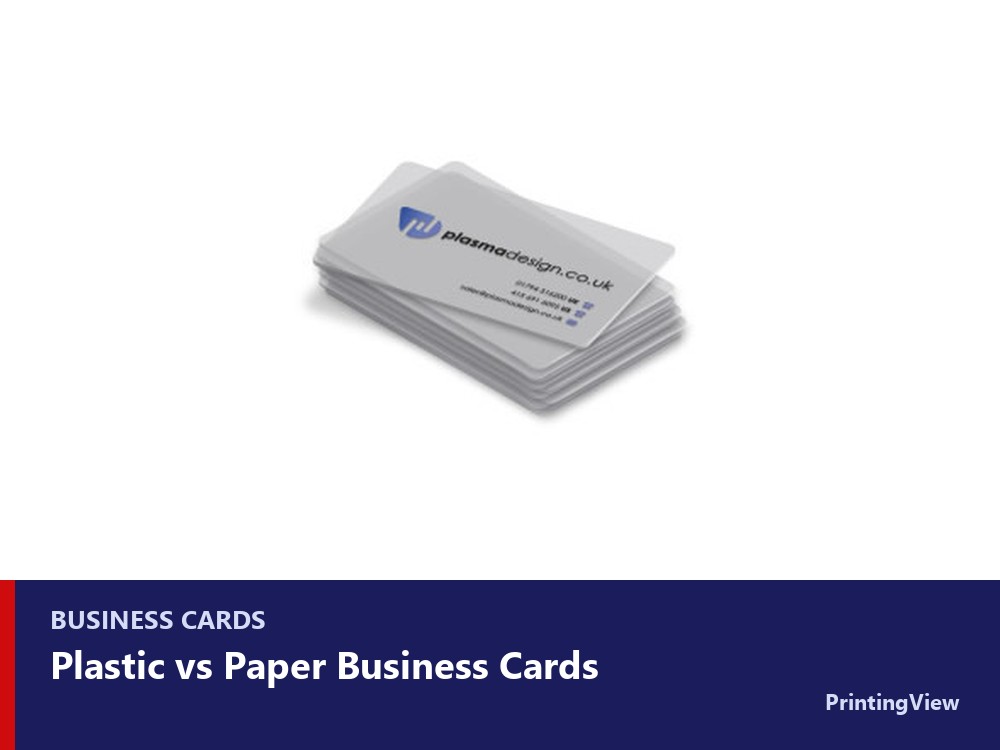
Both materials carry exactly the same information. The difference is how the card feels, how long it lasts and what message the material sends. Paper cards feel traditional and are easy to write on. Plastic cards feel modern and resist moisture and bending.
If you are still deciding on size, stock and finishes for paper cards, start with our business card printing guide.
Side-by-side comparison
| Feature | Paper cards | Plastic cards |
|---|---|---|
| Feel | Classic and familiar, with many stocks and textures | Smooth and modern, with a distinct look |
| Durability | Can bend, crease or wear in a wallet | Resists bending, tearing and moisture |
| Writing on the card | Easy, especially on matte or uncoated stock | Harder; needs a suitable pen or a writable finish |
| Standing out | Depends on stock and finish | Different from most cards people receive |
| Typical cost | Usually lower | Usually higher |
| Recycling | Widely recyclable | Depends on the plastic and local facilities |
Exact options and pricing vary, so check the product pages for standard business cards and plastic business cards.
When paper is the better choice
- You hand out cards in volume and want the lowest cost per card.
- You or your customers often write notes on the card, such as appointment times.
- Your brand is traditional, natural or craft-based.
- You want special paper effects, such as thick stock, soft-touch or textured finishes.
When plastic is the better choice
- The card will be carried for a long time, such as a membership or loyalty card.
- It may get wet, such as in beauty, fitness, outdoor or hospitality businesses.
- You want to look modern or technical.
- You want a card that people remember because it feels different.
Design tips for both materials
- Keep text at 8 pt or larger and leave a safe margin from the trim edge.
- Add 0.125 inch of bleed if colour reaches the edge.
- On plastic, strong contrast and bold logos work well; very thin lines can lose clarity.
- Do not rely on handwriting on plastic cards; print the details you need.
- Supply a 300 dpi PDF with fonts outlined.
How to decide
Ask three questions: how will the card be used, what will it be exposed to, and what should it say about your business? If the answers point to everyday hand-outs, paper is usually enough. If they point to a lasting, premium or water-exposed card, choose plastic. You can also use both: paper for general hand-outs and plastic for important clients.
See our business card printing page to choose a style, or use the free quote form for a custom job. You approve a free proof before printing.
Frequently asked questions
Are plastic business cards better than paper?
Neither is better for everyone. Plastic is more durable and water-resistant. Paper is more traditional, easier to write on and usually costs less.
Can you write on a plastic business card?
It is harder than on paper. Choose a suitable pen or print the details you need so you do not rely on handwriting.
Are plastic business cards waterproof?
Plastic resists water and moisture far better than paper, which makes it a good choice for wet environments.
Do plastic business cards cost more?
They usually cost more than paper cards. Check the product page or request a quote for current options.
Can I print the same design on plastic and paper?
Usually yes, but bold shapes and strong contrast work best on plastic. Check the proof before approving.
Can I get a proof before my cards are printed?
Yes. A free digital proof lets you check layout, colours and text before production.
